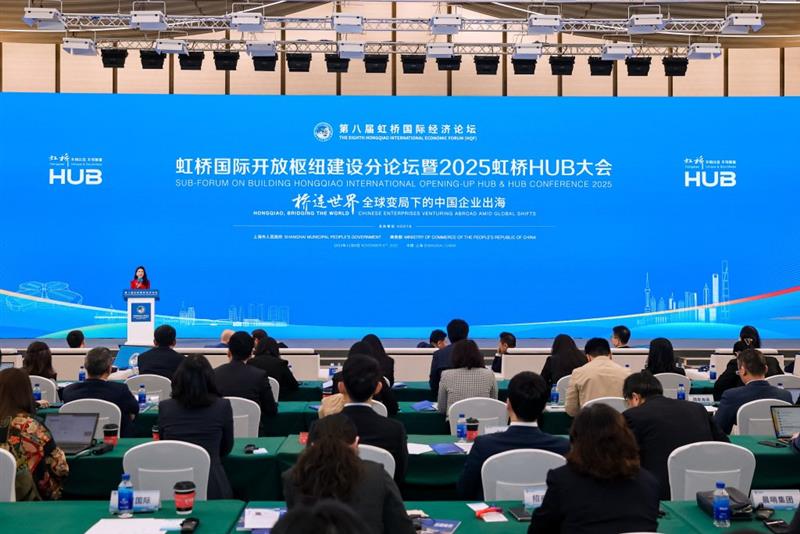
The Hongqiao HUB Conference 2025 takes place at the National Exhibition and Convention Center (Shanghai) on Nov 6. [Photo provided to en.shhqcbd.gov.cn]
As the dust settles on a pivotal year for Chinese commerce, a fundamental shift in the business landscape has become undeniable.
If 2024 was about “recovery,” 2025 has been the year of strategic maturation for “Chinese Enterprises Going Global” (中企出海). This transition reached its crescendo during the fall conference season, where the “Go Global” narrative moved definitively from aggressive scale expansion to “high-quality global operations.”
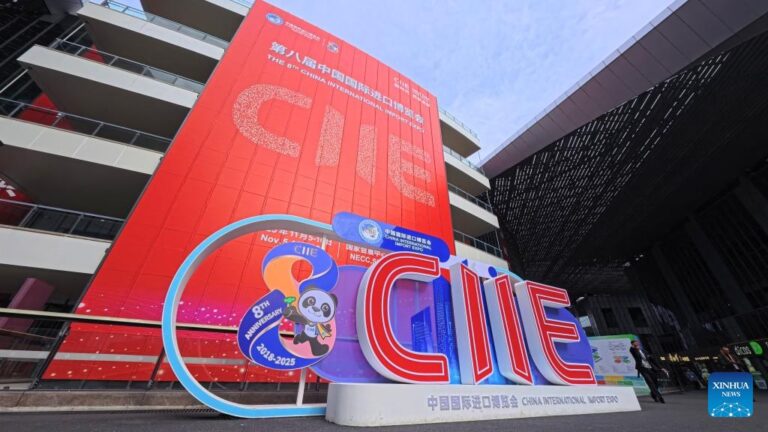
We saw this clearly at the 8th CIIE (China International Import Expo) in November. According to a comprehensive media monitoring report by Wisers, the conversation around “Going Global” has evolved significantly. The data reveals a distinct shift in focus: keywords like “Digital Intelligence” (数智化), “Cross-border Finance” (跨境金融), and “Professional Services” (专业服务) dominated the expo’s social share of voice, far outpacing generic trade terms.
The Insight: Complexity Demands Partnership
This evolution in terminology is not accidental, it signals a maturing market.
The dominance of complex keywords like “Digital Intelligence” and “ESG” proves that Chinese enterprises have graduated from the “survival” phase of simply exporting goods. They are now entering the “thrive” phase of deep localization. Crucially, these new priorities—managing cross-border capital flows, ensuring data compliance, and building green supply chains—are not problems that can be solved with simple off-the-shelf tools. They represent systemic operational challenges that require expert guidance.
Global service leaders recognized this gap immediately. At CIIE, they didn’t just showcase products, they positioned themselves as the missing link in this complex ecosystem. For example, Standard Chartered launched their “Global One” solution not as a banking product, but as an ecosystem to help SMEs navigate the regulatory maze of cross-border settlements. Deloitte and PwC moved the conversation beyond auditing to strategic resilience, using the platform to discuss how AI and ESG compliance are now the “license to operate” for Chinese firms in global markets.
For foreign service providers—whether in legal, financial, consulting, HR, or digital tech—this shift presents a critical opportunity for 2026. But having the right solution isn’t enough. You need the right voice.
At Influence Matters, we have observed that successful B2B engagement in 2026 will depend on positioning your brand not as a vendor, but as a strategic navigator. Here is how we helped clients like TMF Group and ADP seize this narrative—and the impact we achieved.
The 2026 Narrative Shift: From “Going Out” to “Going Up”
For years, the “Go Global” story was about speed and scale. In 2026, the story is about Resilience, Compliance, and Digital Trust.
Chinese CXOs are currently grappling with three diverse pressures:
- Regulatory: Navigating increasingly divergent compliance landscapes in “bridge economies” like Mexico, Vietnam, and Hungary.
- Digital Transformation: Managing global data visibility to turn compliance from a passive cost into an active asset.
- Brand Trust: Building localized, resilient reputations in foreign markets that go beyond price competitiveness.
To win their business, your thought leadership must address these pain points directly.
Case Study 1: TMF Group – Turning Complexity into a Strategic Asset
Leveraging Report Launches for Sustained Visibility
The Challenge:
TMF Group, a leading provider of critical administrative services, produces the flagship Global Business Complexity Index (GBCI). The challenge was to ensure this global data didn’t just land as a “stat sheet” in China, but rather as an essential guide for Chinese multinationals navigating risky markets.
Our Strategy:
We moved beyond a simple press release. We treated the GBCI launch as a strategic thought leadership campaign focused entirely on the “Go Global” narrative.
- Localized Narrative: We contextualized global complexity scores specifically for Chinese outbound investment hotspots (e.g., Southeast Asia, Latin America), making the data actionable for local decision-makers.
- Executive Positioning: We secured interviews and bylines for TMF executives that positioned them as experts on “simplifying the complex,” shifting the conversation from “outsourcing admin” to “mitigating cross-border risk.”
The Impact:
By transforming a single report into a sustained, three-month campaign, we achieved:
- 155 Media Clippings: Securing widespread coverage across top-tier business and trade media in finance, accounting, HR, and legal.
- 172% Increase in Reach: A massive year-over-year jump in visibility, ensuring TMF’s voice dominated the compliance conversation.
- Tier-1 Authority: Positioned TMF as the definitive navigator for Chinese firms entering complex jurisdictions.
Case Study 2: ADP – Defining the “Digital Compliance” Standard
Securing Authority in Tier-1 Opinion Columns
The Challenge:
ADP, a global leader in HR technology, needed to demonstrate how its solutions empower Chinese companies to manage global workforce challenges. The goal was to reach top-level decision-makers who view HR not as back-office admin, but as a strategic compliance function.
Our Strategy:
We focused on the intersection of Digitalization and Global Compliance, aligning with the “Digital Trade” themes highlighted at CIIE. We developed a high-level byline article specifically targeting the strategic concerns of Chinese leaders: “New Advantage in Going Global: Digitally Managing Global Compliance, Moving Beyond ‘Passive Compliance” (出海新优势:应对全球监管数字化,告别“被动合规”).
The Impact:
- Tier-1 Placement: We successfully pitched and placed this article in Caixin (财新), China’s most authoritative financial media outlet.
- Strategic Validation: This placement provided massive third-party validation, positioning ADP not just as a payroll vendor, but as a thought leader shaping the future of global workforce management for Chinese firms.
- Narrative Ownership: The article successfully argued that in 2026, compliance is a competitive data advantage, directly aligning ADP with the “high-quality innovation” agenda of China’s top enterprises.
3 Key Narratives for 2026
Looking forward, how can your organization replicate this success? Here are three narrative pillars we recommend for 2026:
- The “Active Compliance” Mindset: Move the conversation from “avoiding fines” to “operational excellence.” Show how your services allow Chinese firms to be proactive rather than reactive in global markets.
- Hyper-Localization Strategy: It’s not enough to be global. Your content must show Chinese companies how to be “local” in Germany, Brazil, or Indonesia. Demonstrate deep, localized knowledge.
- Data as a Strategic Shield: For digital service providers, emphasize how data visibility protects global operations. Security and transparency are top-of-mind for Chinese CIOs going global.
Looking Ahead: Do You Have a Voice in the Transition?
The “China Go Global” wave is entering its most sophisticated phase yet. Chinese enterprises are actively looking for partners who understand their strategic trajectory—partners who were visible and vocal at CIFTIS and CIIE, and who continue to lead the conversation.
Whether it’s launching a major industry report like TMF Group or defining a new compliance standard like ADP, Influence Matters helps global B2B brands translate their expertise into market authority.
Ready to shape your 2026 narrative? Reach our Emiliy Xu or contact us to discuss your thought leadership strategy.