Following President Trump’s recent visit to China, Chinese media coverage has provided a nuanced and often pragmatic interpretation of what the trip signals, not only for bilateral relations, but for global business dynamics, supply chains, and technology competition.
Drawing on reporting from top business press including Caixin, Caijing, Xinhua, and key industry media, a clear narrative emerges: while political tensions remain unresolved, economic interdependence continues to shape both sides’ behavior, albeit within a rapidly changing structure.
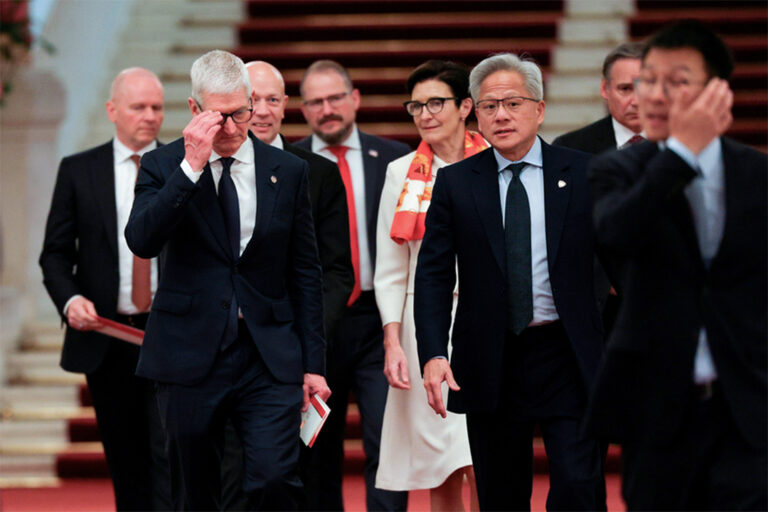
A New Type of U.S. Business Delegation: From Resources to Technology
One of the most consistently highlighted signals is the shift in the composition of the U.S. business delegation.
According to Caixin, the absence of energy and resource companies—previously dominant during Trump’s first visit—marks a generational transition in economic priorities. Instead, the delegation is now heavily weighted toward technology, finance, and advanced manufacturing players.
This evolution is interpreted in Chinese media as reflecting:
At the same time, the presence of companies such as Micron—seeking to “recover” lost ground—illustrates how past disruptions are still shaping corporate strategies today.
Deep Interdependence Remains, Especially for Global Tech Leaders
Despite geopolitical tension, Chinese media strongly emphasizes that U.S. corporate leaders remain deeply tied to the Chinese market.
Caijing frames the delegation as representing “core U.S. commercial forces” that have long-standing and structurally embedded relationships in China.
Apple is the clearest example:
- China remains its primary manufacturing base
- It is also its second-largest consumer market globally
- The ecosystem provides supply chain efficiency, engineering capability, and profitability stability
Within this context, Tim Cook’s participation is interpreted as a strategic move to seek operational certainty amid global volatility.
Chinese commentary therefore positions the visit as a political event as well as a business-critical reset attempt led by multinational corporations themselves.
Official Narrative: Cooperation Still Drives Global Stability
Coverage from Xinhua reinforces a more state-aligned perspective, emphasizing the mutual benefits of continued economic cooperation.
The presence of major U.S. executives is framed as evidence that:
- The U.S. business community still values China’s market opportunities
- China’s industrial ecosystem continues to anchor global production and innovation
- Bilateral cooperation contributes to global economic stability
Tesla serves as a flagship case:
- Its Shanghai Gigafactory has localized 95% of its supply chain
- It has built a dense ecosystem of 400+ domestic suppliers
- Chinese partners increasingly participate in its global procurement system
The broader message is clear: economic integration remains real and operational, even as political narratives shift.
Sector Reality Check: From Interdependence to Partial Decoupling
While macro-level narratives stress cooperation, industry-focused media are more cautious—particularly in the automotive sector.
AutoObserver highlights that the visit underscores a structural transition toward “parallel systems”, especially in autos and mobility.
Key observations include:
- The absence of Detroit giants like GM and Ford signals declining competitiveness in China
- Silicon Valley and new mobility players are driving engagement instead
- Strategic deals focus on new energy, aviation, agriculture, and mid-tier semiconductors
At a policy level, discussions reportedly touched on:
- Cross-border data frameworks for autonomous driving
- Conditional data-sharing arrangements
- Regulatory reciprocity mechanisms
These elements suggest that cooperation is becoming more conditional, regulated, and segmented by sector.
Semiconductor Story: Fragmentation Beneath the Surface
Nowhere is the complexity of U.S.-China relations more visible than in semiconductors.
Industry outlet Xinshiye outlines a fragmented landscape among the four major chip players in the delegation—NVIDIA, Qualcomm, Micron, and Coherent.
Each represents a distinct strategic position:
- NVIDIA: navigating export controls while trying to preserve market access
- Micron: attempting to regain lost ground after China built local capacity
- Qualcomm: maintaining relative stability with limited regulatory disruption
The overarching conclusion is striking:
- Companies that were quiet about their business in China are becoming more involved
- Those that stayed face intensifying local competition
- Formerly dominant players are encountering structural erosion of their advantages
This reflects a broader trend: market access alone is no longer sufficient—competitive positioning is being redefined locally, particularly in support of China’s growing global ambitions.
A Pragmatic Consensus: Engagement Continues, But on New Terms
Across all outlets, a consistent theme emerges: China-U.S. economic ties are neither collapsing nor returning to past norms—they are being restructured.
Chinese media interpretations converge on several key points:
- U.S. businesses remain economically dependent on China, especially in tech and manufacturing
- China is becoming increasingly self-sufficient in critical sectors, reshaping competitive dynamics
- Future cooperation will be selective, regulated, and strategically bounded
In this sense, Trump’s visit is not seen as a breakthrough moment, but rather as a signal of adaptation:
A shift from broad interdependence toward targeted, interest-driven engagement under constraint
Final Takeaway for Businesses
For companies operating across APAC—particularly in tech, semiconductors, and advanced manufacturing—the Chinese media narrative offers a clear signal:
- China remains indispensable—but no longer forgiving
- Global strategies must now be locally competitive, not just globally scalable
- Influence and positioning matter as much as market access
Businesses in China should acknowledge the mutually beneficial business cooperation with their Chinese counterparts, with clear messaging in support of China’s growing independence global presence built on reliable global partners and a supply-chain involving trusted and well established Western companies.
At Influence Matters, we work with B2B companies growing their presence in China by making sure they are noticed by the most important influencers in their field – journalists, analysts, industry experts and influencers – with hyper-targeted, business objective-oriented public relations and marketing services.